|
|
 |
Publisher:  Genre: Flight Sim Genre: Flight Sim
|
|
Mac OS X: 10.2 Mac OS Classic: Not Supported
CPU: G3 @ 600 MHz RAM: 256 MB Hard Disk: 350 MB 4x CD-ROM Graphics: 16 MB VRAM |
|
|
|
Enemy Engaged: Comanche vs. Hokum
January 20, 2005 | Tim Morgan |
|
Enemy Engaged’s graphics are a little outdated but still enjoyable, offering brightly lit daytime raids and superb in-cockpit night lighting. Rain is visually pleasing, with drops collecting on the windshield (and they can even be washed off with the Hokum’s wiper blades). But, for its outdated graphics, FPS are still low, and at the highest detail settings even my G5 performs a little sluggishly at times.
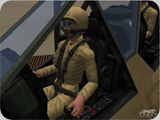
Enemy Engaged simulates a fully 3D cockpit with fluid head positioning, an absolute must for helicopter sims. The pilot can choose to sit in either the pilot or copilot seat, although his/her responsibilities and capabilities are the same for both seats.
The terrain is repetitive and offers only some cover, although detailed modeling of cities and buildings make for interesting urban battles. From the behemoth freighters at port in Taiwan to monstrous castles in the sand in Yemen, downtown centers are interesting distractions from the more pressing matter of the Chaparral that just popped on your radar warning receiver (RWR). Players looking for terrain wrought with cover should play the Sword in the Sand campaign, as Yemen’s mountainous vistas provide for excellent concealment and tricky navigating.

|
The audio is another mixed bag. Volumes are greatly distorted for the benefit of the player: the player’s own helicopter is unrealistically silent, a mere whisper through the speakers. The sounds of nearby aircraft, choppers, and vehicles ring through at unrealistic distances, to the benefit of the player, giving him/her an edge in situational awareness.
The player can issue and receive orders over the radio, and although one cannot hear his/her own voice, the voices of other vehicles across the battlefield play through the radio, in either a cool American voice or a comical foreign accent (which could be Russian). But this is precisely the problem: the radio receives the transmissions from vehicles across the battlefield, meaning an otherwise very useful device is completely over-cluttered with chatter useless to the player.
The radio is simplified, with transmissions coming from three major groups: Other helicopters (which inform you of the progress of your mission), “ground control” (which informs you of the progress of ground troops), and air traffic control (which clears you for takeoff and landing). However, since the entire battlefield speaks to you via your radio, it’s difficult to pick out the stuff that actually matters from the stuff that doesn’t affect the mission at hand. Even worse, voices can overlap and sometimes come in at severely reduced volumes, meaning that important orders (such as wingman status updates or landing clearances) can go unheard. In a positive touch, however, the radio can gain static in bad weather, forcing players to deal with the same problems as their real-life pilot counterparts.
| |