|
 |
|
Gameplay

Sound
|
|
Graphics

Value
|
|
Reader Reviews
58 reviews. Average Rating: 7.07
• |
|
|
Publisher:  Genre: Strategy & War Genre: Strategy & War
|
|
Mac OS X: 10.1 Mac OS Classic: Not Supported
CPU: G4 @ 450 MHz RAM: 256 MB |
|
|
|
Flanged Mace of the Hedgehog
One of the largest parts Dungeon Siege draws from the Diablo series is its equipment. Equipment is fairly non-linear, as you are unlikely to find the same equipment in the same chests or with the same monsters. The naming scheme for the weapons is also fairly Diabloesque, leading me to believe that the equipment is randomly generated based on a set of rules. Non-rare equipment is given a single adjective such as brittle, or sturdy, and magical equipment is given a name such as The Wicked Axe of the Lion, or the Spongy Bow of the Manatee. The damage system is similar as well, with each weapon doing a range of damage (such as 23-37) with that number modified by the character's strength and melee skill. Magical equipment can also grant a variety of bonuses to the characters skills, such as increases to life, mana, character attributes and skills, and armor rating.
Most weapons have certain requirements in their respective character skill or attribute. A large sword might require the character reach a 25 strength and have a melee skill of at least 20 before it can be equipped, while a high level magical robe could require at least a 27 in intelligence before the character could wear it. As with many RPGs, half of your time in this game can be spent shopping and equipping, endlessly tweaking your party to gain maximum efficiency in battle. I wouldn't find it uncommon to spend an hour or two in a town checking through all the equipment I had gathered for anything useful and in the end selling the items I no longer needed to buy even better equipment so I could get my main characters armor up into the 130 range, and find a perfect axe for my dwarf due to a recently raised melee skill.
A Linear Non-Linear World
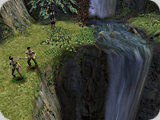
One of the most interesting aspects to the gameplay is the way the world you adventure in has been created. The world is fairly linear, with one main path that you always follow with fairly frequent opportunities for small side adventures. It is difficult to get lost or stuck in an area, there aren't a lot of mazes or other such obstacles to forward progress. While many times this can be a negative factor for a game, especially an RPG where exploration can be half the fun, Dungeon Siege pulls it off very successfully due in part to the overall circumference of the game. The areas are still huge and can take a long time to get through, expect to put in many hours hacking your way through caves and caverns, forests and dales; only to arrive at a town or conveniently placed shop to restock and head out again. While the large game size is certainly a factor in Dungeon Siege's ability to make a linear game feel non-linear, its complete lack of load time between worlds is easily the most inventive feature of the game. There are no doorways to click on forcing you to wait as the next area is loaded up, everything is a continuous extension of the world. There is a small load time when you first enter into the world, but after that there isn't a progress bar in sight. In fact, if you wanted to walk all the way back to the farm you started from you could. This is certainly an aspect that other developers should catch on to, and hopefully it can become a trend in newer RPGs.
For RPGs in the current market, much of the success of the game can depend on how well multiplayer support is integrated into the game. Both Diablo and Neverwinter Nights offer an expansive and formative multiplayer realm, a section of the game that easily rivals the single player component for depth and interest. Dungeon Siege does contain multiplayer support, but its current incarnation is one of the few parts of the game that was slightly disappointing. The Macintosh online community at the time of this review was very small, so the best bet to get in some multiplayer slashing is to gather a group of friends on a LAN or have someone host a game over the internet. Once you get into the server, it plays like a more difficult version of the single player game in a different world. In the end, it can easily be fun, but without servers massed with people, RPGs in a multiplayer environment can get stale.
|
|